News & Press

Read the latest stories and announcements from Scite. Writing a story about Scite? Contact us at customersupport@researchsolutions.com

Press Releases

Citation Classics Is Back

Starting in 1977, Eugene Garfield's Citation Classics series at ISI invited the authors of highly cited papers to write short commentaries on their own work. Over 15 years, more than 4,000 scientists told the stories behind their most influential publications: the failed experiments, the lucky breaks, the collaborators who made the difference. It was one of the most human things ever done with citation data.

Read more
Introducing Scite MCP

Starting today, you can connect Scite to the AI tools you already use. Search 250M+ articles, evaluate research with Smart Citations, and access full-text PDFs - all without leaving your workflow.

Read more
Bringing Smart Citations to Rankings

We are now pleased to present our first annual rankings report for fields, institutions, and journals

Read more
On Joining Research Solutions

We’re excited to enter a new phase of our journey at scite by coming together with [Research Solutions](https://www.researchsolutions.com/). The motivation behind this decision was our desire to further our mission of introducing the next generation of citations and better serve our users, publishers, and the scholarly ecosystem for the long term.

Read more
Colabra and scite Partner on the Development of Citations Block

Brooklyn, NY — February 23, 2023 — scite, an award-winning tool that helps researchers discover and understand research findings more efficiently through Smart Citations, has partnered with Colabra, provider of a modern GxP-compliant Electronic Laboratory Notebook (ELN) and project management tool, to enhance the citation experience on the Colabra platform.

Read more
SPIE and scite Partner on the development of Smart Citations

scite has partnered with SPIE, the international society for optics and photonics, to enhance the research experience on the SPIE Digital Library.

Read more

View All Press Releases

Awards

ISMTE
ISMTE People's Choice Award
ALPSP
ALPSP Award for Innovation in Publishing
NSF
NSF Phase 1 SBIR Grant
NIH
NIH/NIDA SBIR Fast-track grant
Vesalius Prize
Vesalius Prize Runner Up

Company News

Slide 1 of 6
Future
Nature
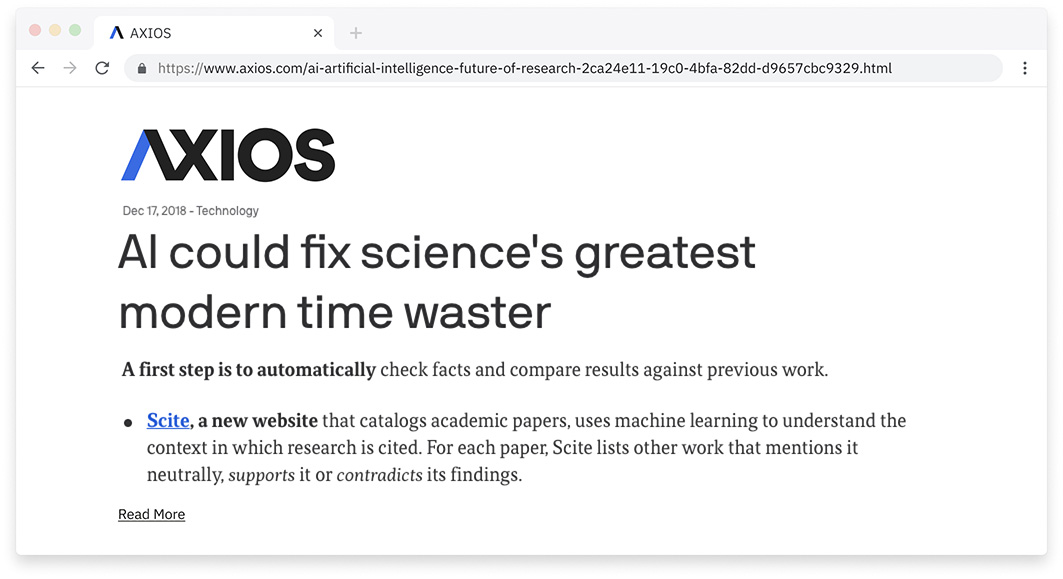
Axios
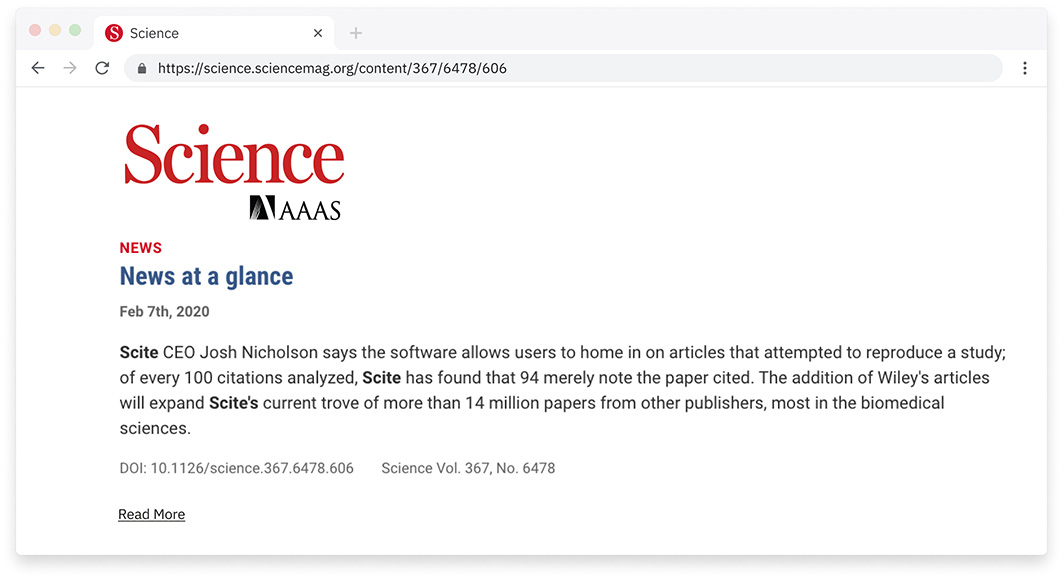
Science
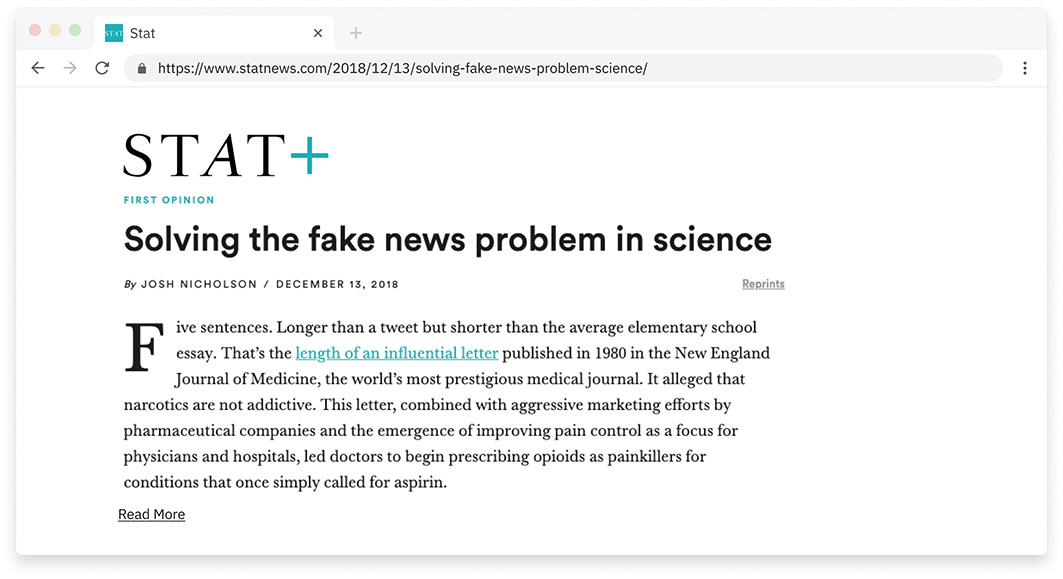
Stat-Plus
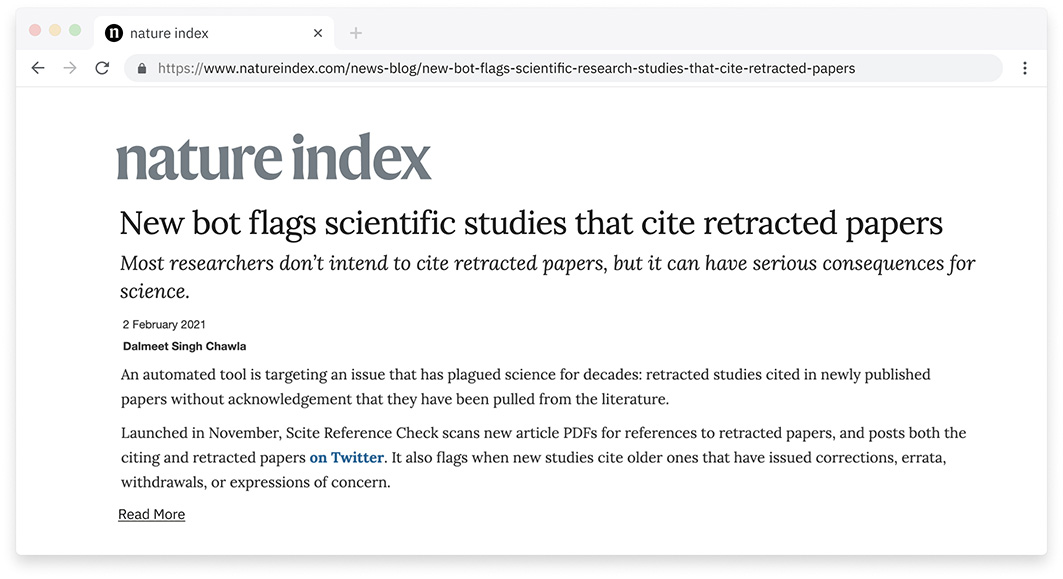
Nature-Index
Future
Nature
Axios
Science
Stat-Plus
Nature-Index
Future
Nature
Axios
Science
Stat-Plus
Nature-Index
Future Logo
Nature Logo
Science Logo
Axios Logo
Stat-Plus Logo
Nature-Index Logo

Organizations We Serve

uhksmucshlhkusttsmsbucbuclalawuniversity-of-gavle

Click here to request a demo or configure a trial for your organization.

Integrations & Partnerships

aibccccharleswortheifligrouphkustjacek-lewinsonlean-libraryonlinebilgirssamscholarcyspringernaturewritefulrupbmjkragerfmgwileyiopcupepmcmbcthiemesagefrontiersapsiucrarxivemerald

Let us know if you want to work together at customersupport@researchsolutions.com

Research using Scite

Exaggerated anticipatory anxiety is common in social anxiety disorder (SAD). Neuroimaging studies have revealed altered neural activity in response to social stimuli in SAD, but fewer studies have examined neural activity during anticipation of feared social stimuli in SAD. The current study examined the time course and magnitude of activity in threat processing brain regions during speech anticipation in socially anxious individuals and healthy controls (HC). Method Participants (SAD n = 58; HC n = 16) underwent functional magnetic resonance imaging (fMRI) during which they completed a 90s control anticipation task and 90s speech anticipation task.